

ElevenLabs launched in 2023 to help indie authors and creators make audiobooks. It was built by engineers from Google and Palantir. This platform has a Creative Suite for text-to-speech and an Agents Platform for voice assistants.
In this honest elevenlabs reviews piece, you’ll see why creators like Leeanna Morgan and Joseph Nassise chose ElevenLabs. They wanted to cut narrator costs and speed up production.
In this in-depth elevenlabs review, we’ll explore the Studio workspace, voice cloning, and multilingual models. We’ll also look at the Projects workflow for chapter-based content. You’ll get an expert opinion on ElevenLabs. This will help you decide if it’s right for your audiobook, podcast, or e-learning needs.
Key Takeaways
- ElevenLabs offers ultra-realistic voice synthesis and browser-based tools for creators.
- Voice cloning and multilingual support make it useful for audiobooks and e-learning.
- Creators report major cost and time savings, but the marketplace is still growing.
- This honest elevenlabs reviews piece gives practical pros and cons to evaluate.
- Expect frequent updates and an active community that shapes features.
What ElevenLabs Is and Why It Matters for Creators
ElevenLabs is a web-based AI voice platform for creators. It offers fast, realistic audio without needing local software. You can make audiobooks, podcasts, and voiceovers in your browser.
The platform supports text-to-speech and voice cloning. It also has a voice library and tools for multiple narrators. You can export your work in MP3 and WAV formats.
The company was started by Google and Palantir engineers. They use deep learning for natural speech. This includes context-aware intonation and emotional nuance.
They also offer Audio Native and Dubbing Studio. These tools help with translation and audio refinement.
Quick platform overview
You work in a Projects workspace with organized chapters and scenes. Actor Mode lets you record a sample for voice guidance. It supports multiple narrators for different voices.
Speech-to-speech technology keeps emotional delivery consistent. This is great for dubbed content and voice continuity.
Who benefits most
Indie authors and nonfiction writers can make audiobooks without narrator fees. YouTubers and podcasters save time with consistent voiceovers. E-learning creators, marketers, game developers, and agencies also benefit from speed and cost savings.
Whether you’re solo or part of a team, ElevenLabs has a tier for you. Choose from free, Pro, Scale, or Enterprise based on your needs.
Key features at a glance
Voice cloning offers instant and professional options. Emotion control sliders and Actor Mode help with mood and pacing. Projects and chapter management keep your work organized.
Audio Native and Dubbing Studio focus on quality audio and translation. ElevenReader offers direct publishing with a revenue share model.
Reviews praise ElevenLabs for its realistic and fast audio. Podcast hosts and indie authors appreciate the cost savings and speed. When comparing voices, look for authentic reviews to understand the trade-offs.
elevenlabs reviews: Pricing, Pros, Cons, and Real-World Performance
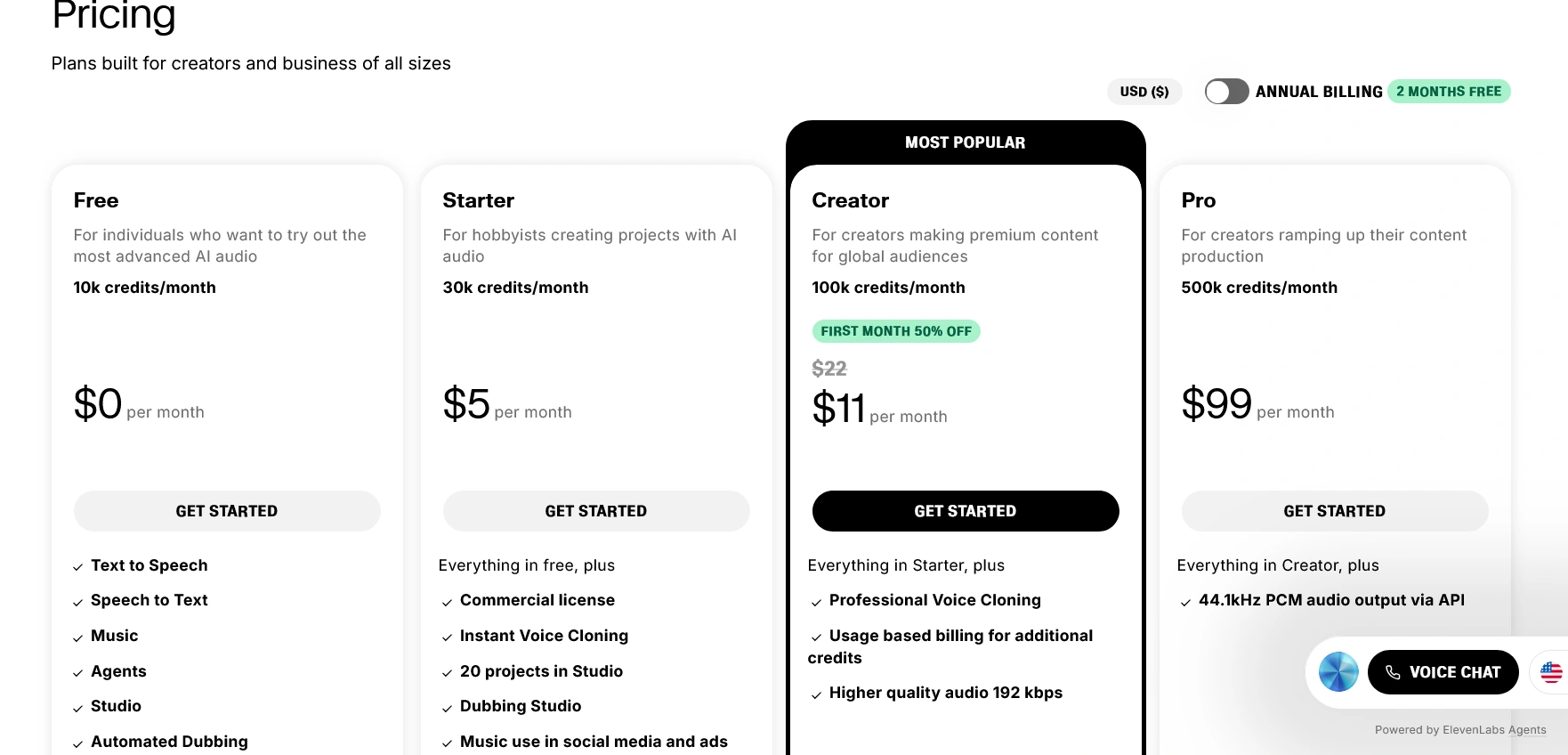
When you read top-rated elevenlabs reviews, you’ll see a clear price ladder. This section explains what each tier offers, the benefits you’ll see daily, and the common drawbacks. It also shares real-world performance examples to help you decide if ElevenLabs is right for your projects and budget.
Pricing tiers and what they get you
The free plan lets you use 10,000 characters a month for noncommercial use with attribution. Starter costs about $5 a month and adds around 30,000 characters. Creator at $22 unlocks 100,000 characters, instant cloning, and Projects for organizing your work.
Pro at $99 raises the limit to 500,000 characters, adds professional cloning, commercial licensing, and priority support. Scale and Enterprise plans start at $330 and offer custom levels like 2M characters, custom voice design, and account management.
Remember, credits are used per generation and per edit. Unused credits are not refunded and are lost after cancellation. Heavy revision cycles can make costs rise quickly.
Major advantages you’ll notice
Many honest elevenlabs reviews praise the platform for voice realism and emotional nuance. You get high-quality narration across languages, fast rendering for long scripts, and multi-narrator handling for character-driven projects. This can save you thousands of dollars compared to hiring human narrators for a full audiobook.
Creators report stable results for podcasts, e-learning, YouTube narration, and quick product demos. Projects and direct distribution tools help you manage long-form output with less manual overhead.
Common drawbacks and real-user tradeoffs
In-depth elevenlabs review notes mention editing time as a frequent pain point. Expect to spend hours adjusting pacing, pauses, and pronunciations. Each regeneration can consume credits, so iterative fixes become expensive. Instant cloning works well for prototypes, but professional cloning gives higher fidelity for commercial releases.
Some reviewers found the ElevenReader audience small for distribution. The free plan’s commercial restrictions and the “use it or lose it” credit policy push heavier users toward paid tiers.
| Plan | Monthly Price | Characters / Credits | Key Inclusions |
|---|---|---|---|
| Free | $0 | 10,000 | Attribution required, noncommercial use, basic voices |
| Starter | $5 | 30,000 | Expanded characters, basic editing, good for short projects |
| Creator | $22 | 100,000 | Instant cloning, Projects, better throughput for creators |
| Pro | $99 | 500,000 | Pro cloning, commercial license, priority support |
| Scale | $330 | 2,000,000 | Custom voice design, account management, enterprise features |
| Enterprise | Custom | Custom | Tailored licensing, SLAs, and bespoke integrations |
Performance examples from tests
Tests on nonfiction and fiction reveal different workflows. For a nonfiction chapter, you’ll want a steady, neutral voice. Testers used a voice called “Matt” and adjusted 0.5-second pauses around subheadings to fix pacing. That process required paragraph-by-paragraph review and manual fixes for proper nouns.
Fiction testing showed strong character work when you assign different voices. Dialogue usually reads naturally, though tags and rapid emotional shifts sometimes need manuscript edits. Users creating clones in minutes saw quick wins for intros and tutorials, while professional cloning delivered the best match for narrators on paid releases.
Across many top-rated elevenlabs reviews, listeners often couldn’t tell short-form content was AI. For long-form audiobooks, you should budget time for edits. The balance between quality, speed, and cost is the central tradeoff you’ll manage when using ElevenLabs.
How to Get Professional Results with ElevenLabs: Workflow and Tips

To get great audio from ElevenLabs, start by preparing well. Edit your text for speaking, cutting out visual stuff and shortening sentences. Work on one chapter at a time to keep things simple and avoid wasting credits.
Think about how your text sounds when spoken. Use short sentences and clear punctuation to control the pace. Check how names and technical terms sound when spoken to ensure they’re correct. If you like a casual tone, rewrite tricky parts to fit the Audio Native style.
Preparing your manuscript for audio
Divide your text into smaller parts and polish it before uploading. Replace images and charts with text or links for notes. This saves credits and makes it easier to fix any mistakes users might point out.
Choosing and tuning voices
Look through the voice library and filter by age, gender, accent, and tone. Choose a voice that fits your content well. For facts, pick a steady voice. For stories, use different voices to add depth.
Adjust the stability and clarity settings based on your content. Use higher stability for facts and lower for stories. Enhance clarity or similarity on final versions. Try out different voices and keep them consistent for a cohesive release.
Managing credits and edits efficiently
Credits are used for each generation and rework. Make sure your text is right before finalizing. Work on one paragraph at a time and group similar edits to save credits. Use Projects to organize and track your work.
Choose a plan that suits your needs. Creator and Pro plans offer more characters and cloning options. Use the free tier for testing, then upgrade for more features. Listen to user feedback to catch any issues that might cause extra work.
Post-production and distribution tips
Export your audio in MP3 or WAV and do some light editing. Add chapter markers if needed. ElevenLabs exports work well with many platforms. Consider ElevenReader for direct publishing.
If you’re making videos, add TTS audio to your edits to save time. Dubbing Studio is great for keeping character consistent in translations. For quick or cost-effective options, consider AWS Polly or Google Cloud TTS. But for quality, ElevenLabs is the best choice.
Readers often talk about preparation, voice choice, and credit management in elevenlabs reviews. Follow these steps to improve your audio, save credits, and get great feedback.
Conclusion
After a detailed elevenlabs review, it’s clear: ElevenLabs offers some of the most realistic AI voices. These voices are perfect for audiobooks, YouTube voiceovers, podcasts, e-learning, and marketing. The platform’s features, like voice cloning and speech-to-speech, make it cost-effective compared to hiring narrators.
Yet, honest elevenlabs reviews also point out some downsides. You’ll need to spend time editing the voice’s pacing and pronunciation. An 80k-word audiobook might take 10–20 hours to fine-tune. Also, making changes can cost credits, and using the platform a lot can increase your bill.
ElevenReader offers a 60% royalty, which is great. But, its audience is smaller than major distributors. So, think about your distribution goals and the savings you’ll get from using ElevenLabs.
If you’re an indie author or a creator who cares about voice quality, ElevenLabs is a good choice. It’s also great for course producers who need to update their content often. Start with the free tier and upgrade as needed.
For big fiction projects or those that need top-notch narration, consider a mix. Use human narration for major releases and ElevenLabs for other content. This approach is recommended in many top-rated elevenlabs reviews.
To get the most out of ElevenLabs, follow the testing tips and workflow steps. It’s not a quick fix, but with careful editing and the right approach, it can save you a lot of money. For those looking into elevenlabs reviews, it’s a powerful tool if you’re willing to learn and manage your costs.
FAQ
What is ElevenLabs and who founded it?
ElevenLabs started in 2023 as a web-based AI text-to-speech platform. It focuses on audiobook creation, voice cloning, and high-quality voice synthesis. It was founded in 2022 by former Google and Palantir engineers. Since then, it has grown to include products like Studio workspace, Audio Native, Dubbing Studio, and an Agents Platform for voice assistants.
What core features does ElevenLabs offer?
ElevenLabs offers text-to-speech, instant and professional voice cloning, and a library of AI voices. It also supports multi-narrator projects and has a Projects workspace for chapter management. You can use Actor Mode for influencing delivery and speech-to-speech features. Audio Native is for audio-optimized content, and Dubbing Studio is for translated dubbing. The Studio is browser-based and supports export to MP3/WAV and direct publishing options.
How realistic are the voices and does the platform handle emotion?
ElevenLabs is known for ultra-realistic voices with strong emotional range and context-aware intonation. Reviewers say the voices are natural and expressive, perfect for audiobooks, YouTube, e-learning, and marketing. You can adjust expressiveness with stability and clarity sliders and use Actor Mode to influence cadence.
How many languages and accents does ElevenLabs support?
The platform supports dozens of languages and many accents. It includes tools to fine-tune pronunciation for proper nouns and technical terms.
What pricing tiers are available and what do they include?
ElevenLabs has a free tier (roughly 10,000 characters/month with attribution and no commercial use) and paid tiers: Starter (~$5/month with 30k characters), Creator (~$22/month with 100k characters, instant cloning, Projects), Pro (~$99/month with 500k characters, professional cloning, commercial licensing), Scale (~$330/month with 2M characters and account management), and Enterprise custom plans. Credits/characters are consumed per generation and per regeneration.
Are unused credits refundable or transferable?
No. Unused credits are not refundable and are typically lost if you cancel your subscription. Plan carefully and avoid excessive test regenerations to minimize wasted credits.
How much editing time should you expect when producing an audiobook?
Real users report roughly 10–20 hours of editing for an 80k-word audiobook. This is to fix pacing, pronunciation, pauses, and dialogue flow. Expect to work chapter-by-chapter, pre-polish your manuscript, and batch edits to reduce credit waste.
What are common drawbacks or tradeoffs when using ElevenLabs?
Common tradeoffs include significant manual editing for long-form projects, credit consumption during revisions, occasional technical glitches that force regenerations, higher cost for heavy or enterprise use, and a smaller audience on ElevenReader despite a 60% royalty for direct publishing.
How do instant cloning and professional cloning differ?
Instant cloning can produce usable voice matches quickly from short samples (1–5 minutes) and is great for prototyping. Professional cloning requires longer samples (often ~30 minutes) and human review for higher fidelity and nuanced delivery. Professional clones tend to be better for flagship projects and long-form narration.
Can ElevenLabs be used for commercial projects?
Yes, commercial use is allowed on paid tiers (Pro and above include commercial licensing). The free tier carries attribution and typically restricts commercial use. Always confirm licensing terms in your subscription plan before publishing commercially.
How should you prepare a manuscript for best results?
Prepare an audiobook-friendly manuscript: remove or adapt visual references, simplify complex sentences, adjust dialogue tags, and add punctuation or pauses to control pacing. Work chapter-by-chapter to avoid burning credits and pre-test phonetic spellings for names and technical words.
What are best practices for choosing and tuning a voice?
Browse the voice library and filter by age, gender, accent, and tone. For nonfiction use higher stability for clarity; for fiction use lower stability to allow expressiveness. Test multiple voices, use Actor Mode for cadence when needed, and keep voice consistency across a project. For final production, consider professional cloning for the highest fidelity.
How do you manage credits and avoid wasted usage?
Validate and polish text before generating, work paragraph-by-paragraph, batch edits, monitor stability/clarity settings during testing to reduce re-renders, and use the Projects workspace to organize chapters. Start on the free tier to test workflows before upgrading.
What post-production and distribution options are available?
Export audio as MP3 or WAV. Use basic post-production—level normalization, noise removal, chapter markers—before distribution. You can publish directly to ElevenReader (60% royalties) or distribute through other channels like Spotify, InAudio, Kobo Writing Life, and Google Play Books for broader reach.
When should you choose ElevenLabs over alternatives like AWS Polly or Google Cloud TTS?
Choose ElevenLabs when voice realism, emotional nuance, and long-form consistency matter—such as audiobooks, storytelling, and branded content. Consider alternatives for real-time synthesis, lower per-character costs, or fully managed, low-edit requirements. A hybrid workflow (human narration for flagship titles, ElevenLabs for backlist) is often optimal.
Is ElevenLabs suitable for YouTube creators and podcasters?
Yes. Many YouTubers and podcasters use ElevenLabs for voiceovers and episode narration. The platform saves studio time, supports rapid iterations, and maintains consistent voice across long scripts. Use Audio Native for polished spoken delivery and Dubbing Studio for multilingual needs.
How accurate is pronunciation for names, brands, and technical terms?
Pronunciation is generally strong but often requires manual adjustments—phonetic spellings or small text edits—to nail uncommon names, brands, or technical vocabulary. Expect to tweak and re-render affected sections to ensure accuracy.
What kind of support and community does ElevenLabs offer?
ElevenLabs maintains an active user community and releases frequent updates. Paid tiers offer priority support; Scale and Enterprise plans include account management and customized assistance.
Will listeners be able to tell the voice is AI?
In many use cases listeners cannot tell the voice is AI, thanks to ElevenLabs’ advanced technology. Highly trained human narration still edges out AI for certain high-end fiction or deeply nuanced performances. But ElevenLabs often passes casual listening tests and works well for most creator needs.
What are the best use cases for ElevenLabs?
Best use cases include indie authors with backlists, nonfiction audiobooks, YouTube voiceovers, podcasts, e-learning courses, marketing audio, tutorials, and rapid prototyping with speech-to-speech. It scales from casual free-tier users to enterprise customers needing custom voice solutions.