
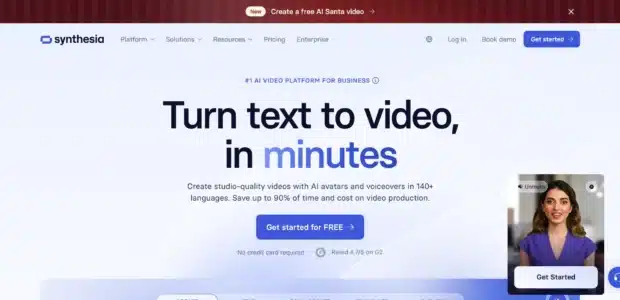

there was a good reason why thousands of companies rely on this tool. The process that once took 4 hours now wraps up in just 30 minutes . Companies save up to 80% of their time and budget .
Synthesia AI creates lifelike digital avatars that can speak your script in more than 120 languages . The tool impressed me with its ability to turn standard documents and PowerPoints into engaging training and marketing videos without needing cameras or actors. The pricing structure makes sense too – starting at $18 monthly for 180 minutes of yearly video content . Users can also opt for a free plan that provides 36 minutes per year .
You might wonder if this AI video creator justifies the cost and if it can take the place of traditional video production. This review will share what I learned from my hands-on experience with the platform. I’ll cover its strong points, limitations, and show you how different businesses can use it effectively.
What Is Synthesia AI and Who Is It For?
Synthesia AI has revolutionized how businesses create videos. This AI-powered platform lets users produce professional videos without cameras or actors. Companies can now scale their video content faster than ever before.
AI Video Creation Without Cameras or Actors
You don’t need expensive equipment or awkward filming sessions with Synthesia. The platform uses advanced AI to create studio-quality videos straight from your text. This new approach makes video production available to everyone while keeping costs down and quality high [1].
A typical 10-minute lecture video used to take 3-5 hours to produce. Now, I can create the same content in just 30-45 minutes using Synthesia’s AI video generation [2]. These time savings add up quickly when you’re making multiple videos.
Companies that use Synthesia save up to 90% on their video production costs [1]. These savings come from eliminating:
- Camera equipment and studio space
- Professional videographers and editors
- Actors or presenters
- Multiple recording sessions for different languages
The platform gives you unmatched flexibility compared to traditional filming. Need to update your content? Just edit the script and create a new video. You won’t need to schedule another recording session. This feature helps especially when you have training materials that need regular updates.
Target Users: Marketers, Educators, and HR Teams
After creating over 100 videos, I’ve seen three groups benefit the most from Synthesia:
Marketing teams use Synthesia’s AI video features to create product demos, promotional content, and branded videos with consistent messaging. They can quickly make content for different channels without filming everything again.
Educational institutions and training departments find it’s the quickest way to create engaging lessons. Teachers can turn their scripts into videos in multiple languages, making their materials available to students worldwide. Most instructional designers now create videos 90% faster, taking less than an hour [3].
HR teams love the platform for employee communications, onboarding, and compliance training. Since 90% of users can make their first video without help [1], even HR teams with basic tech skills create professional content. That’s why 90% of Fortune 100 companies trust Synthesia [3].
How Synthesia Works: Text-to-Video with Avatars
The process is simple. You start by entering content in one of four ways: type a text prompt, paste your script, upload a document (like PowerPoint or PDF), or provide a URL to transform web content [1].
Next, pick from over 230 AI avatars [4] to deliver your script. These avatars look realistic with natural gestures, head movements, and facial expressions that match your script’s tone. You can also customize videos with different backgrounds, add your logo, and choose from more than 1,000 voice options [1].
Just click “Generate” and Synthesia creates your complete video in minutes. Once it’s done, you can translate it into any of the 140+ supported languages [1] with one click, reaching audiences worldwide instantly.
The platform includes extra features that make it even more powerful:
- Built-in screen recording for software demos and tutorials
- Interactive elements like embedded questions and clickable hotspots
- PowerPoint import capabilities
- Shared editing for team feedback
This all-encompassing approach to video creation has made Synthesia the go-to solution for businesses that want to scale their video communications without increasing costs or complexity.
Hands-On Feature Review After 100+ Videos
I’ve spent countless hours making videos and really tested every feature Synthesia has to offer. My hands-on experience shows what’s great about the platform and where it falls short.
AI Avatars: Realism and Customization
Synthesia’s AI avatars are the star of the show, and they’re remarkable. The platform has over 230 AI avatars that represent different ethnicities, genders, and professional personas [5]. These avatars stand out because they study real human facial expressions and speech patterns. This makes sure their lip movements match the speech and their emotional gestures look natural [6].
The Express-2 avatars are a game-changer with:
- Full-body visibility with synchronized body language
- Multiple camera angles you can switch between
- Better lip-sync and facial expressions that match the emotional tone [5]
Companies looking to create branded content have several options. Enterprise users can add logos to avatar clothing [5], and all paid plans let you change clothing colors [5]. The newer customizable avatars let you choose any outfit and background. Thanks to Veo 3.1 technology, avatars can act in these environments [5].
Voice Cloning and Multilingual Support
The voice cloning quality is a big deal as it means that what I expected. You can clone a voice in less than 15 minutes [7], and it keeps your natural speaking style, intonation, and accent elements—nothing robotic about it [7].
The multilingual support is a huge plus. Your cloned voice can speak in 32 different languages [7], while the platform’s stock voices work with over 140 languages and dialects [8]. This is a great way to get content for global teams since your personal avatar can speak in 29+ languages without extra recording [7].
Templates and Scene Editing Tools
Synthesia’s template library made my workflow much faster. You get 60+ pre-designed video templates [9] that you can find in the top bar, left menu, or when you create new videos or scenes [2].
Templates come with multiple scene layouts, and you can filter them by video format (landscape/portrait/square) [2]. Enterprise users get access to branded templates and brand kits [2][9].
The scene editing interface hits the sweet spot between power and simplicity. Your videos can have up to 50 scenes [2]. Each scene lets you add avatars, text overlays, images, and videos. You can animate these elements with entrance/exit effects and set precise timing triggers [2].
Bulk Personalization and PowerPoint Import
Two features help you create content at scale. The PowerPoint import feature turns presentations into videos quickly. Upload a .pptx file (up to 1GB, 150 slides) [10], and Synthesia converts the slides. It keeps elements editable and can turn speaker notes into video scripts [10].
Bulk personalization is another powerful tool available on Creator and Enterprise plans [11]. You can upload a CSV or Excel file with your data, map columns to template variables, and create multiple videos at once [12]. After processing, you get a spreadsheet with shareable links for each video [12].
AI Video Assistant and Dubbing Features
Synthesia’s AI dubbing is impressive because it translates video content while keeping lip movements in sync. The system keeps the speaker’s original tone and delivery style [13], so translations look natural without needing subtitles.
You can dub videos up to 5GB or 2.5 hours long with resolutions up to 4K [13]. Synthesia transcribes your content after upload and lets you check and fix any errors before processing. This helps ensure technical terms and company names translate correctly [13].
This dubbing feature alone makes Synthesia worth it for businesses that need to reach global audiences without starting from scratch.
Synthesia Pricing Plans: Which Tier Offers Best Value?
My detailed review of Synthesia’s pricing structure shows clear value at each tier. The platform’s recent price drop to $18/month makes this AI video creator available to small businesses and people who want to scale their video production.
Starter Plan: $18/month – What You Get
The Starter plan costs $29/month with monthly billing but becomes $18/month with annual billing [1]. This entry-level plan has:
- 120 minutes of video per year (equivalent to 10 minutes per month) [4]
- Access to 125+ AI avatars [1]
- Three personal avatar slots [3]
- Simple AI dubbing capabilities [1]
- Watermark-free videos [1]
- One editor account with three guest commenter slots [3]
My tests show this plan works well for solo creators or small teams that make occasional videos. The price point is reasonable, but the annual video limit can hold back growing businesses. Teams that need frequent video content might need to buy additional minutes, which adds to the total cost [14].
Creator Plan: $64/month – Is It Worth It?
The Creator plan costs $89/month with monthly billing or $64/month annually [1]. This plan expands capabilities with:
- 360 minutes of video per year (30 minutes monthly) [4]
- Over 180 AI avatars including selected industry-specific options [3]
- Five personal avatar slots [3]
- Advanced features like API access and multiple avatars per scene [1]
- Interactive video capabilities [1]
- Branded video pages with customization options [3]
This tier delivers the best value to serious content creators who need extra customization. The triple video allowance plus premium voices and custom fonts justify the higher price for businesses that produce regular video content. API access lets you integrate with existing processes—a vital feature to scale production [3].
Enterprise Plan: Custom Features and Support
The Enterprise plan offers custom pricing based on organizational needs [1]. Key features include:
- Unlimited video minutes [4]
- Access to all 230+ stock AI avatars [1]
- Unlimited personal avatars (under fair use) [3]
- Advanced capabilities like 1-click translations into 80+ languages [1]
- Team collaboration tools with SAML/SSO integration [3]
- SCORM export for learning management systems [4]
- Dedicated customer success manager and priority support [3]
Large organizations with extensive video needs will benefit from this plan as it removes the minute restrictions of other tiers. Traditional video production often costs more than $1,000 per minute, so even Enterprise pricing can deliver strong ROI for companies creating extensive training or marketing materials [3].
Free Plan Limitations and Watermarking
Synthesia has a free option with major restrictions:
- Limited to either 3 minutes per month or 36 minutes per year (sources vary) [1][4]
- Access to only 9 basic AI avatars [3]
- Prominent Synthesia watermark on all videos [3]
- No video downloads in some cases [5]
- Restricted editing and export features [3]
The watermark creates the biggest problem as it shows your content was made with a free tool, which affects professional branding [5]. Free tier users also face strict limits on commercial usage rights [5].
The free plan works best as a demo of what’s possible rather than a long-term solution. You can review the platform before buying a subscription, but watermarks and limited features restrict its practical use.
Pros and Cons After Long-Term Use
My hands-on experience with Synthesia shows its impressive strengths and noticeable weaknesses that only become clear after creating many videos. The platform’s value is different based on what you need it to do.
Top Benefits: Speed, Ease, and Multilingual Reach
Synthesia’s quickest way to create videos stands out as its biggest advantage. Videos usually take just 3-8 minutes to generate, which is much faster than traditional production methods [7]. You can now complete in 30 minutes what used to take 4 hours [8].
The platform’s accessible interface deserves praise. Users can quickly learn the workflow: upload a script, select an avatar, choose a background, and generate [7]. This simple process explains why 90% of users can create their first video without any tutorial.
The multilingual features are a great way to get results for global organizations. Synthesia supports over 140 languages and accents, which makes shared content localization easy [15]. I created training materials in multiple languages without needing translators or voice actors—this opens up huge possibilities for international teams.
Limitations: Avatar Emotion, Movement, and Pricing
The truth is, Synthesia’s avatars still can’t match natural human expression. The digital presenters look artificial despite marketing claims. They have basic facial expressions and robotic-looking gestures [7]. Their eye contact looks unnatural, and while the synthetic voices are technically good, they lack human warmth and variety—you’ll notice this monotony in longer videos [7].
The customization options have major limits. You don’t get many background choices, and you can’t upload custom environments or create your own visual styles [7]. Synthetic Avatars optimize speed and brand fit over realism, with fewer facial expressions than stock avatars [16].
Visual glitches happen more often in longer scenes, so shorter ones work better [16]. The avatars’ movements and gestures show clear limitations—they can’t handle object interactions or demonstrations well [16].
Support and Moderation Issues
Content moderation is one of Synthesia’s most annoying aspects. Business videos often get rejected without proper explanation [7]. Healthcare training materials, educational content, and product demonstrations face random restrictions [7].
Synthesia uses automated systems and human reviews to check if content follows their policies [17], but this approach often goes too far. They block politics, religion, health claims, legal advice, financial advice, and adult content—sometimes even factual, educational presentations get caught in this net [17].
Support quality changes based on your plan. Free users only get AI chat support, while Enterprise customers receive dedicated, priority help [15]. There’s an appeals process for moderation decisions [18], but users report long waits and generic answers to technical problems [7].
Looking at these strengths and limitations shows that Synthesia works best for quick, simple business communications, but it struggles with emotional depth or complex presentations.
Best Use Cases for Synthesia AI Video
My extensive testing shows that Synthesia AI works better for some tasks than others. You’ll get the best value from your Synthesia pricing plan by knowing which situations fit best.
Training and Onboarding Videos
Employee training stands out as one of Synthesia’s best uses. The platform turns basic onboarding materials into videos that keep new hires engaged. Every employee gets the same information, which solves the problem of different trainers teaching things differently [2].
The platform really shines when you need to turn existing documents into videos. You can quickly change PDFs, slides, documents, and webpages into polished training modules with the AI video assistant [2]. Companies have cut their production time by 75-90% compared to old methods [9].
The benefits go beyond just saving time. Companies using Synthesia for training see real results:
- 91% completion rates for blended learning approaches
- 83% better long-term retention compared to text-only training
- Each video costs $650-$5,000 less than traditional production [9]
Teleperformance shows how well this works. This global customer experience company created custom training in 27 languages, which led to shorter training times and better employee understanding [19].
Marketing and Product Demos
Product demonstrations are another area where Synthesia really stands out. Marketing teams can create professional demo videos without needing special editing skills [20].
The platform has a great feature for product marketing. You can record your product right in your browser and turn it into an editable demo video instantly [20]. Then you can add clickable CTAs and different paths to guide users through your product, making demos more interactive and useful.
Making product videos with Synthesia gives you flexibility. When features change, you can update your existing video and create a new version in minutes instead of scheduling new filming sessions [10].
Internal Communications and Updates
Corporate communications often struggle to keep people interested—but Synthesia helps solve this. The platform turns regular company updates into eye-catching videos that employees want to watch.
Synthesia makes executive communications easier to scale. You can create custom avatars for senior leaders so they can stay visible without spending time on filming [12]. This works especially well for companies with employees around the world who need regular updates.
AI video has changed how companies reach frontline workers. Communication specialists say it creates mobile-friendly content that employees can watch during breaks without a computer [12]. This solves a big challenge of reaching non-desk workers.
Multilingual Content for Global Teams
Creating content in multiple languages might be Synthesia’s most impressive feature. Videos can be translated into 140+ languages right away while keeping the same timing and tone [20].
This changes everything for international organizations that need localized content. One global company cut their translation time from 6 months to 2 weeks per language. They could roll out compliance training in 15 markets at once instead of one at a time [9].
The 1-Click Translation feature keeps the original voice and style [20]. Your message stays consistent no matter the language—which matters a lot for global brands.
Inter IKEA shows these benefits well. Their Learning Technology Implementation Leader says they’ve “democratized learning for [their] global workforce by transitioning from subtitled English-only master videos to culturally relevant, locally adapted content” [11]. Every employee gets information in their preferred language, which helps them understand and engage better.
After making over 100 videos, I’ve found you get the best results by using Synthesia for these specific purposes rather than trying to replace all traditional video production.
Synthesia vs Traditional Video Production
My experience testing Synthesia AI revealed clear differences from traditional video methods. The benefits extend beyond simple convenience to completely transform production costs.
Cost and Time Comparison
Traditional video production gets pricey quickly, with costs typically ranging from $800 to $10,000 per minute of finished content [21]. Synthesia’s subscription plans start at just $18 per month [22]. The cost difference comes from eliminating several expensive elements:
- No studio rentals or physical filming space
- Zero camera equipment and lighting gear expenses
- No professional crew or technicians
- No actor/talent fees [23]
The time savings are even more impressive. Traditional videos take weeks to produce, while Synthesia creates similar content in hours. This cuts production time by 70-90% [24]. A typical training video might take 4 weeks and cost $8,500 with traditional methods. Synthesia can deliver the same results in one day [23].
When to Use AI vs Real Actors
AI video has its limitations despite these advantages. Traditional production with real people makes more sense for high-impact presentations, especially when you have sales and marketing where first impressions matter [13]. It’s worth noting that Synthesia uses a real founder in their own walkthrough video instead of an AI avatar [13].
AI works best for internal communications, training modules, and multilingual content where clear information delivery matters more than production quality.
Alternatives Like HeyGen and Elai
HeyGen stands out among competitors with better lip-syncing and facial expressions, making it a good choice for marketing videos [13]. Elai.io gives users more control over video creation with extensive customization options [6]. Colossyan focuses on learning and development with specialized training features [25].
Synthesia leads the enterprise market with ISO certifications and consent-based avatar governance, making it ideal for companies that need security and compliance [25].
Conclusion
My extensive testing of Synthesia AI in hundreds of videos shows this platform definitely deserves a spot in any modern content creator’s toolkit. The platform can turn what used to take days into a matter of minutes, which marks a radical alteration in how businesses create videos efficiently.
The most impressive thing about Synthesia is how it makes video creation available to everyone. Organizations used to need special equipment, technical know-how, and big budgets. Now, anyone can create professional videos through a simple text-to-video process that gives consistent results.
Synthesia has its drawbacks though. The avatars don’t always capture emotional subtleties, and the content rules can feel too strict at times. Traditional video production still makes sense for critical external communications where real human connections matter most.
My hands-on experience shows Synthesia excels in specific areas – especially when you have internal training needs, multilingual content, and regular communications where clear information matters more than polished production. Companies that need frequent content updates will love how quickly they can change videos without booking new shoots.
The pricing plans fit different needs, but you should think over your video requirements to decide if the Starter plan is enough or if Creator/Enterprise features are worth the cost. The platform gives great returns when used strategically rather than as a complete replacement for traditional production.
AI video technology will keep evolving toward better realism and emotional depth. Right now, Synthesia gives organizations a powerful way to scale their video communications without adding more costs or complexity.
Despite its limitations, Synthesia AI is a breakthrough that revolutionizes business video production – making professional content creation available to almost anyone. The platform’s time savings, cost reduction, and multilingual capabilities are a great way to get ahead, even with its current constraints.
FAQs
Q1. How does Synthesia AI compare to traditional video production in terms of cost and time? Synthesia AI offers significant cost and time savings compared to traditional methods. While traditional video production can cost $800-$10,000 per minute and take weeks, Synthesia allows users to create comparable content in hours at a fraction of the cost, with plans starting at $18 per month.
Q2. What are the best use cases for Synthesia AI videos? Synthesia AI excels at creating training and onboarding videos, product demonstrations, internal communications, and multilingual content for global teams. It’s particularly effective for transforming existing documentation into engaging video format and enabling quick content updates.
Q3. How realistic are Synthesia’s AI avatars? While Synthesia’s AI avatars have improved, they still have limitations in emotional expression and natural movement. The avatars analyze human facial expressions and speech patterns to match lip movements with speech, but they may appear artificial in longer videos or when complex emotions are required.
Q4. What languages does Synthesia support for video creation? Synthesia offers extensive multilingual capabilities, supporting over 140 languages and dialects. This feature allows for easy content localization and enables businesses to create videos in multiple languages without hiring translators or voice actors.
Q5. Are there any content restrictions when using Synthesia? Yes, Synthesia employs content moderation to ensure videos align with their policies. Restricted topics typically include politics, religion, health claims, legal advice, financial advice, and adult content. Users sometimes report legitimate business videos being rejected, though an appeals process is available.
References
[1] – https://www.synthesia.io/pricing
[2] – https://www.synthesia.io/tools/onboarding-video-maker
[3] – https://www.zebracat.ai/post/synthesia-review
[4] – https://www.eesel.ai/blog/synthesia-pricing
[5] – https://reelmind.ai/blog/synthesia-free-video-limitations-when-to-upgrade-to-premium-models
[6] – https://www.puppydog.io/blog/heygen-alternatives
[7] – https://autoposting.ai/synthesia-review/
[8] – https://www.synthesia.io/features
[9] – https://www.synthesia.io/post/ai-video-for-learning
[10] – https://www.synthesia.io/marketing
[11] – https://technologymagazine.com/articles/how-synthesias-180m-funding-boosts-the-ai-video-revolution
[12] – https://www.synthesia.io/post/how-to-upgrade-your-internal-communications-strategy
[13] – https://zapier.com/blog/synthesia-ai-video/
[14] – https://www.eweek.com/artificial-intelligence/synthesia-review/
[15] – https://cybernews.com/ai-tools/synthesia-ai-review/
[16] – https://docs.synthesia.io/docs/synthetic-avatars
[17] – https://help.synthesia.io/en/articles/8417043-content-moderation-faqs
[18] – https://help.synthesia.io/en/articles/11199905-our-approach-to-content-moderation-at-synthesia
[19] – https://www.synthesia.io/post/multilingual-tts-systems
[20] – https://www.synthesia.io/tools/product-demo-video-maker
[21] – https://www.paracast.io/blog/ai-vs-traditional-video-production-cost-and-time-analysis/
[22] – https://www.synthesia.io/post/heygen-alternatives-competitors
[23] – https://www.synthesia.io/post/ai-training-videos-save-time-costs
[24] – https://www.truefan.ai/blogs/ai-video-production-cost-guide
[25] – https://www.synthesia.io/post/best-elai-io-alternatives